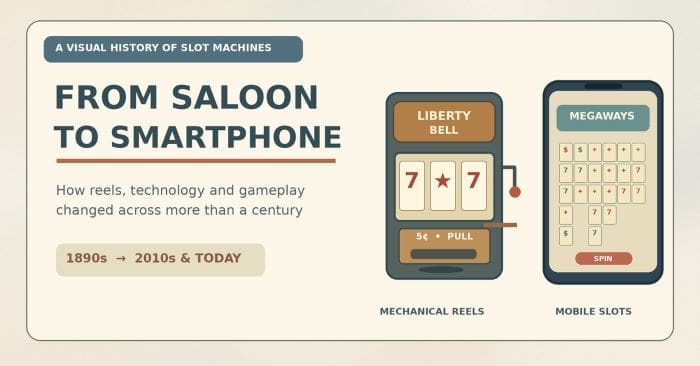
Picture a San Francisco BAR in 1895. The floor is sticky. Cigar smoke lingers at eye level. There’s a cast iron box in the corner about the size of a microwave with a lever on its side. Drop in a nickel, pull, and three metal drums spin around until they finally come to rest one by one. If three Liberty Bells line up, the machine dispenses ten nickels into a tray all by itself with no bartender to oversee it.
Next picture someone sitting alone on a packed commuter train in 2026 tapping a glowing button on their phone while 117,649 possible symbol combinations cascade downward onto a six reel grid. That’s quite a long journey covering approximately 130 years. However, looking at the development of slot machines allows us to see how little changed. A small wager, spinning a wheel, receiving a random outcome and getting immediate payment — that’s still all that matters. All other aspects are simply decoration.
Before the bell: Poker Machines & payouts made in cigars
You’ll find it difficult to find anyone who claims charles fey created the slot machine. He certainly didn’t create it first, but he deserves credit for creating an Automatic payout model on a very basic three-reel format.
Poker Machines and Automatic payouts
Prior to the creation of the Liberty Bell, a poker machine was developed by a group known as Sittman and pitt in Brooklyn in 1891. While most historians accept this as the predecessor of all modern slots, there were many issues with the machine. The machine had five drums on each drum there were fifty card faces. Due to these large numbers of possible winning hands, it was impossible for a simple mechanism to automatically detect winning lines and distribute payouts. Therefore, bartenders evaluated patrons‘ hands and awarded them house items based upon their hand strength. For example, Two pairs of kings could be rewarded with a complimentary beer whereas a royal flush could award patrons a cigar or another drink for free. Many operators removed the ten of spades and the jack of hearts from the reels which effectively reduced winning potential by roughly half — therefore creating the house advantage in its simplest form.
Liberty bell
Charles Fey was born in Germany. He was a mechanic operating in San Francisco at the time he created the Liberty Bell. His solution was elegant simplicity — reduce the possible outcomes. Instead of having five drums and 50 card faces, Fey chose three reels with five symbols — horseshoe, diamond, spade, heart, and cracked Liberty Bell. The fewer possible combinations enabled fey to design a machine capable of reading a winning line and distributing payments automatically.
This is truly the innovation behind the Liberty Bell. Sources vary as to when Charles Fey actually designed and constructed it. Some sources suggest as early as 1888 while others propose as late as 1899. Regardless, it is agreed upon that it was around 1895.
The Liberty Bell utilized three reels and five symbols. three bells lined up produced ten nickels ($0.50), which was actual money at the time for BAR patrons.
Mechanical slot machines
The mechanical slot machine operated on pure mechanical principles. Each time a customer pulled on a lever located near the front of the slot machine, it wound up a spring and subsequently released three reels. Braking mechanisms along with timers determined when each reel would come to rest. Notch disks were located behind each reel on the same shaft that held each symbol. Upon each reel coming to rest, feelers would fall into notches located on each disk, determining whether or not a winning combination existed. Should a winning combination exist, a coin delivery system would open releasing any earned monies into a tray located at the bottom of the slot machine. Pure mechanical elements completed all functions requiring no human interaction to determine payouts.
As we can clearly see, mechanical slot machines were able to operate independently and generate profits for owners. Mechanical slot machines were able to be placed in virtually any corner of any establishment and continue earning profit without an owner being required to actively monitor its operation.
Electro-mechanical slot machines
During the early part of the twentieth century, mechanical slot machines underwent significant improvements. These improvements included solenoid-controlled braking systems which functioned similar to electrical switches allowing for additional features such as increased payouts for multi-line betting. Additionally, electro-mechanical slots introduced larger jackpots due to longer payout tubes.
Video slots: where metal drums become screens
There is one limitation associated with physical reels: there are limitations to how many symbols you can place on each reel and consequently how many possible combinations you can offer customers. Ultimately, offering large jackpots became problematic since you cannot guarantee large payouts without losing substantial amounts of money.

Two factors helped alleviate this issue: video slots and random number generators (RNGs). The first video slot debuted at the Las Vegas Hilton in 1976 utilizing a modified 19-inch Sony color tv. The game was initially rejected by regulators since it utilized electronic displays that resembled coin-operated vending machines. After modifying the game to prevent tampering, regulators approved its use in Nevada. IGT purchased fortune coin co., which built the first video slot, shortly thereafter and expanded upon their idea eventually developing video Poker Machines that dominated BAR tops during the 80’s.
Random number generators and progressives
With video slots generating vast amounts of odds for potential payouts, it was inevitable that companies would develop methods to link multiple machines together sharing funds for large jackpots. Prior to IGT’s megabucks program in 1986, Progressive Jackpots existed but they were nothing compared to IGT’s megaprogressive format. Although casinos still utilize Megabucks today, it paved the way for future progressive programs.
Video slots take center stage
Mobile technology further fueled growth among developers by enabling consumers to access gaming anywhere, regardless of location or time zone.
Second screen bonus rounds
WMS Gaming created reel ‘em in in 1996, which is credited as the first video slot to introduce second-screen bonuses on u. soil. Players could land a predetermined combination and pause play while accessing a second screen where they could choose fish spots where they wished to fish and see what they caught.
Online gambling begins
Although online casino gaming did not formally begin until 1996 in Antigua and Barbuda when they issued licenses for online gambling operators and Microgaming developed their first online casino software package, the Kahnawake Gaming Commission issued its first license in Canada in 1996 and InterCasino launched as one of the world’s first real money online casinos using CryptoLogic software.
Microgaming’s Cash Splash and who created online slots?
Although several companies’ early efforts toward developing online slots exist – primarily prior to Microgaming’s Cash Splash – there is no clear evidence as to who specifically developed online slots first.
Microgaming’s Cash Splash, released circa 1998, is credited as one of the first online progressive slots.
Early years for online slots
Most early online slots ran on Adobe Flash or Java. Consumers could either download casino clients on their Windows PCs or load Flash games directly into their browser. Microgaming’s library grew exponentially during this period. They developed numerous titles such as Thunderstruck II and Immortal Romance that still have strong followings today. In addition, Microgaming launched Mega Moolah in 2006, which became synonymous with online progressive slots worldwide.
Mega Moolah remains one of the largest progressive slots currently available, with progressive payouts exceeding ten million euros several times throughout its existence.
Other questions regarding slot machine History:
Who developed slot machines?
Charles fey typically receives credit for developing slot machines although Sittman and pitt developed a poker machine with five drums containing 50 cards in 1891 which is considered by many as precursor to modern slot machines. Fey contributed significantly through designing an Automatic payout system utilizing three reels with five symbols.
What was the first video slot?
Fortune Coin’s 1976 model featuring modified Sony Trinitron TVs is considered the first video slot.
First electronic mechanized slot?
Bally’s Money Honey which was designed in 1963 and distributed in 1964 is generally considered as first successful electronic mechanized slot machine.
First progressive slot?
While there are examples of progressives dating back even further; however IGT’s megabucks program released in 1986 is arguably first large-scale progressive slot machine.
When did slots begin to be played online?
From the mid-90s, when Antigua and Barbuda permitted online casinos; however, the majority of the first true casinos were established within the subsequent decade.
When were mobile slots introduced?
Java-based mobile slots began appearing in the mid-2000s; however, mobile slots gained popularity with widespread adoption of smartphones in the early/mid-2010s, using HTML5 instead of Flash.
How does RNG operate?
An RNG constantly generates values many times per second, which are mapped to corresponding reel positions when the player clicks the spin button.
Why did Flash stop functioning?
Flash failed to function properly on iPhones; poor performance on mobile; security concerns that persisted for decades ultimately resulted in Adobe discontinuing support for Flash at the end of 2020, thereby forcing manufacturers to rebuild all Flash-based slots using HTML5.
Can I play slots on my phone?
Yes, provided you reside within a jurisdiction permitting online gaming, are registered with a legitimate operator, and are using a compatible mobile browser or application.